Waterfall Countertops: Everything You Need to Know Before Installing
You’ve seen it on Pinterest, in design magazines, and probably in that one kitchen renovation show you’ve been binging. The countertop that doesn’t stop at the edge — it keeps going, all the way down to the floor in one seamless, dramatic sweep.
It looks incredible. And it is incredible, when it’s done right.
But before you tell your contractor “I want that,” there are a few things worth knowing — about the cost, the cabinet requirements, the fabrication process, and whether your kitchen is
actually a good candidate for this design in the first place. Let’s get into it.
What a Waterfall Countertop Actually Is
A waterfall countertop is exactly what it sounds like. Instead of stopping at the edge of a
kitchen island or cabinet, the surface material continues vertically down one or both sides, flowing all the way to the floor — just like water over the edge of a cliff.
Waterfall kitchen islands came to real prominence in the early 2010s, gaining incredible popularity in high-end, modern kitchen design. The goal is for all sides to appear to be made from one continuous countertop material.
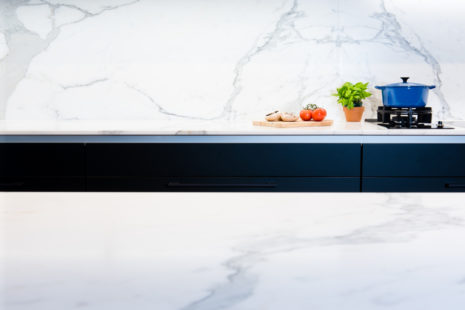
The visual effect is bold, architectural, and immediately signals that a kitchen was designed with intention. When the veining of a stone slab flows from the top surface down the side panel without breaking — that’s the moment that makes people stop and stare. ● –●ç
How It’s Made: The Fabrication Process
This is where things get technical — and expensive. You can’t just extend a regular countertop down the side of a cabinet. The material has to be cut and joined in a very specific way.
Manufacturers cut the slab precisely with a computer numerical control (CNC) laser cutter, producing mitered edges — each piece cut at 45 degrees — that fit together seamlessly to create a perfect 90-degree angle.
When planning for a waterfall effect, each piece must align perfectly at the seams to create a continuous pattern. That process is known as “bookmatching” or “vein matching,” especially for materials with visible veining like marble or granite. Skilled fabricators use CNC machines to ensure accurate cuts — an unqualified installer can inadvertently cause misalignment or stress cracks.
This is not a DIY project. Full stop. The precision required for a clean, seamless result takes specialist-level skill and equipment.
What It Costs — Real Numbers for 2025
Here’s where most homeowners get surprised. Waterfall countertops cost meaningfully more than standard countertops, and the price adds up in three places: more material, more complex fabrication, and more installation time.
For a single waterfall side, expect to add $1,500 to $2,500 to your standard countertop project. Double waterfall islands — where both ends cascade to the floor — typically add $3,000 to
$5,000 or more.
The fabrication process using CNC cutters to create precision mitered joints adds an extra
$1,500 to $2,500 to your bill, depending on the stone and labor.
On average, homeowners building a waterfall kitchen island in 2025 can expect a total price range of $3,000 to $10,000 or more, depending on material, size, and complexity. A basic custom kitchen island without a waterfall edge typically costs between $900 and $6,500 for comparison.
Here’s a full breakdown by material:
| Material | Material Cost (per sq ft) | Installed Cost (per sq ft) | Notes |
| Quartz | $65 – $130 | $75 – $150 | Best for seamless vein matching |
| Granite | $60 – $140 | $70 – $160 | Unique, heat-resistant, needs sealing |
| Marble | $85 – $200 | $100 – $220 | Most luxurious, highest maintenance |
| Quartzite | $90 – $200 | $110 – $230 | Premium look + durability |
| Porcelain Slab | $55 – $120 | $65 – $140 | Lightweight, UV-resistant, low maintenance |
| Concrete | ~$250 total (materials) | Higher labor cost | DIY-possible, unique finish |
| Butcher Block | $150 – $300
(materials) |
Lower labor vs. stone | Warm look, DIY-friendly |
Sources: Bob Vila, Angi 2025, PK Floors, Granite Guy Inc. 2025
One smart way to manage the budget: do just one waterfall side — only on the visible side of your island. Choosing quartz over marble also reduces labor costs because the engineered consistency makes seams easier to match.
How Waterfall Countertops Interact With Your Cabinets
This is the section most people skip — and then regret. Your kitchen cabinets are not just a
backdrop for the waterfall. They’re a direct structural part of the installation, and compatibility matters.
Electrical outlets need to be planned around it
The electrical building code requires a kitchen island to include at least one power outlet for every 24 inches of an island. The typical go-to location is on the side panels of the island — but if those panels are covered in stone, you need to plan around that from the start.
Options include pop-up outlets on the countertop surface, outlets built into column millwork at the end of the island, or outlets integrated into a front-facing facade. This needs to be figured out before fabrication starts — not after.
Cabinet structure must support the weight
Heavy materials like granite or quartz need reinforced cabinets. Cabinets constructed with sturdy plywood or MDF can safely bear heavier slabs. Overhanging countertops, such as
kitchen islands or breakfast bars, require additional support brackets or corbels.
If your existing island cabinets aren’t built to handle the lateral load of a stone panel running floor-to-ceiling, they’ll need to be reinforced — or replaced. This is a conversation to have before the countertop is ordered.
Seating overhangs require structural support too
To accommodate bar seating comfortably, allow for 15 to 18 inches of overhang with proper structural support — whether hidden corbels or internal steel braces — under the waterfall countertop edge.
Storage access can be lost
Waterfall island designs often conceal storage within side cabinetry or drawers, which can be lost if both ends of the island are wrapped in stone. If maximizing storage is important,
consider using a single waterfall edge and keeping the other end open for drawer access or floating shelves.
Kitchen clearance matters
Allow at least 42 to 48 inches of clearance between the island and perimeter countertops for smooth movement, especially if multiple cooks use the kitchen simultaneously.
Waterfall Countertops and Cabinet Style: What Works
The material and the cabinet style need to speak the same design language. A waterfall countertop is a bold architectural statement — it looks natural in some kitchen styles and genuinely out of place in others.
Best cabinet pairings for a waterfall:
- Flat-front (slab) cabinets in matte or gloss finishes — the clean lines match the seamless stone perfectly
- Two-tone cabinets — dark lower cabinets with a light waterfall stone create high- contrast drama
- Open-concept layouts — the island becomes a sculptural centerpiece visible from other rooms
- Handleless or integrated-handle cabinetry — keeps the sleek, uninterrupted look going
Cabinet styles that don’t pair as naturally:
- Raised-panel or shaker cabinets in traditional finishes — the ornate detail competes with the waterfall’s clean lines
- Rustic or farmhouse-style cabinets — the contemporary feel of a waterfall can feel like a mismatch
- Very small or galley kitchens — waterfall islands fit best in modern, contemporary, and Mediterranean kitchens. Without thoughtful design, they can look out of place in farmhouse, cottage, coastal, and traditional kitchens.
For the ultimate cohesive look, use the same material for your waterfall countertop on the
kitchen backsplash or a nearby feature wall. Contrast a light-colored waterfall with rich, dark wood cabinetry on the base for a dramatic, high-impact look — or vice versa.
Pros and Cons: The Honest Version
| What You Gain | What to Watch Out For |
| Instant focal point — transforms the island into a design centerpiece | Costs 20–50% more than a standard countertop installation |
| Protects cabinet sides from scuffs, moisture, and daily wear | Permanent — difficult and expensive to modify later |
| No exposed edges that can chip or wear down over time | Not suitable for all cabinet styles or kitchen layouts |
| Ideal for open-concept kitchens with high visibility | Requires specialist fabricator — not every shop can do it well |
| Consistent, non-porous surface (with quartz or porcelain) | Can reduce access to side storage if done on both ends |
| Adds resale value in the right market | Pattern matching on natural stone adds cost and complexity |
Is a Waterfall Countertop a Trend or Here to Stay?
It’s a fair question to ask before spending $5,000 to $10,000+ on a design feature. Waterfall countertops are gaining momentum in 2025 due to the rise of minimalist and luxury kitchen design trends. They signal custom work and design investment, especially when installed in high-traffic, visible areas like kitchen islands.
The honest answer: waterfall countertops have been a fixture in high-end kitchen design for over a decade now. They’re not a flash-in-the-pan trend. The waterfall edge design is primarily suited for modern, contemporary, or minimalist kitchen designs — and in those spaces, it creates a breathtaking focal point with a high-end, luxurious look.
If your kitchen style and layout are the right match, it’s not a trend you’ll regret. It’s an upgrade you’ll show off for years. C+.
Quick Checklist: Is Your Kitchen Ready for a Waterfall?
Before you commit, run through these:
- Your kitchen is open-concept or has a visible, prominent island
- Your cabinet style is flat-front, contemporary, or transitional
- You have at least 42–48 inches of clearance around the island
- Your electrical outlets can be relocated or planned around the waterfall panels
- Your island cabinets can support or be reinforced to bear the stone panel weight
- You’re working with a fabricator who specializes in mitered stone edges
- Your budget allows for $3,000 to $10,000+ depending on material and configuration
If most of those check out — you’re probably a great candidate. If several don’t, it’s worth rethinking the design or adjusting the scope before anything gets ordered.
Let’s Design It the Right Way
A waterfall countertop is one of those upgrades that either looks like a million dollars or looks like a missed opportunity — and the difference is almost entirely in the planning and execution.
Our team specializes in exactly this kind of work: matching the right countertop material to your cabinet style, planning around your layout, and fabricating the seamless edges that make the whole thing worth doing.
Come visit our showroom to see full slab options in person, or reach out today for a free consultation and custom quote. Let’s build a kitchen that stops people in their tracks — for all the right reasons.