How to Choose the Right Kitchen Cabinet Style for Your Home
Your cabinets are not just storage. They’re the first thing anyone sees when they walk into your kitchen, and they set the tone for everything — the countertops, the hardware, the lighting, all of it.
They also represent about 40% of your total renovation budget. And 78% of homeowners report regretting rushing their cabinet choices during kitchen renovations.
That’s a big number. And it makes sense — because unlike a backsplash or a paint color,
cabinets are not something you swap out on a whim. The right style, chosen thoughtfully, will make your kitchen feel pulled together for decades. The wrong one will bug you every single morning.
So here’s how to actually choose, without the overwhelm.
Start with Your Home’s Architecture, Not Just Your Mood Board
This is where most homeowners go wrong. They fall in love with a style on Instagram, order it, and then realize it fights with the bones of their home.
Your home’s architecture is your starting point, not your Pinterest board. A Craftsman bungalow, a colonial, a mid-century ranch, and a modern townhome all call for different
cabinet languages. When the cabinetry matches the era and structure of the home, the kitchen feels intentional. When it doesn’t, something always feels a little off — even if you can’t quite name it.
Ask yourself these questions before falling for any particular door style:
- Does my home have mostly straight, clean architectural lines or curved, ornate details?
- Are my ceilings high or low? (This affects how much visual weight the cabinets should carry)
- Is my home open-concept or compartmentalized?
- What’s the overall vibe — warm and traditional, or sleek and contemporary?
Your honest answers to those four questions will narrow your options significantly before you ever step foot in a showroom.
The Main Cabinet Styles — What They Are and Who They’re For Shaker Cabinets
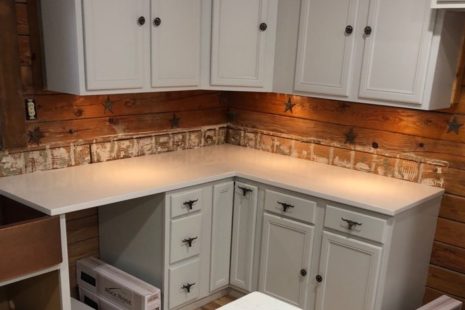
Shaker is the most popular cabinet style in North America — and has been for years. Shaker doors have dominated kitchen design for the better part of two decades, and their popularity shows no signs of fading.
The design is deceptively simple: a five-piece door with a flat recessed center panel surrounded by a clean square frame. No ornate carving. No heavy molding. Just quiet, confident structure.
Shaker cabinets seamlessly integrate into various kitchen styles, from traditional to
contemporary, making them a safe choice for homeowners concerned about future resale value.
The one honest drawback? The recessed panel can trap dust and grease, requiring more thorough cleaning compared to flat surfaces. A soft brush attachment on your vacuum handles it easily, but it’s worth knowing going in.
Best for: Transitional, farmhouse, coastal, Scandinavian, modern-classic, and traditional kitchens. Essentially any style except ultra-modern minimalist or highly ornate classical.
Flat Panel (Slab) Cabinets
Flat panel — also called slab — strips the door down to its most basic form: one unbroken, smooth surface with no frame and no panel. It’s the purest expression of modern kitchen design.
Slab doors emphasize the material itself. When built from a beautiful wood like walnut or white oak, the grain pattern becomes the entire visual story. When finished in a high-gloss lacquer or matte solid color, they create the sleek, uninterrupted lines that define contemporary kitchen design.
Maintenance is genuinely easier — no grooves for grease to hide in. But scratches and nicks are more visible because there are no design details to hide them. In a busy family kitchen, that’s worth thinking about.
Best for: Modern, minimalist, Japandi, and contemporary kitchens. Especially strong in open- concept layouts where the cabinets are visible from living and dining areas.
Raised Panel Cabinets
Raised panel is the classic choice for traditional and formal kitchens. The center panel is
elevated rather than recessed, often with a beveled edge, giving the door a sense of depth and dimension that the other styles don’t have.
Cabinets with overly ornate raised panel designs featuring heavy carvings are becoming less prevalent in 2025 as homeowners shift toward cleaner aesthetics. But a simpler raised panel
— without the heavy routing and elaborate crowns — remains beautiful in the right home.
Raised panels tend to gather more dust in decorative areas, and their visual weight can make a compact kitchen feel cluttered, especially in darker finishes.
Best for: Traditional, formal, and classic colonial-style homes. Not well-suited for modern or minimalist kitchens.
Inset Cabinets
Inset cabinets are built so the door sits flush inside the cabinet frame, rather than overlapping it. The result is a furniture-like, tailored look that feels genuinely handcrafted.
They’re the most expensive option due to the precision required in construction and installation. But in the right kitchen — especially a high-end traditional or transitional space — nothing else achieves quite that level of craftsmanship.
Best for: Luxury traditional, English cottage, and high-end transitional kitchens with generous budgets.
Style Comparison at a Glance
| Cabinet Style | Best Kitchen Aesthetic | Maintenance | Relative Cost | Resale Appeal |
| Shaker | Transitional,
farmhouse, classic modern |
Moderate (grooves need cleaning) | Mid-range | Highest — broadest buyer appeal |
| Flat Panel
/ Slab |
Modern, minimalist, contemporary | Easiest — wipe clean | Lowest to mid | Strong in modern markets |
| Raised Panel | Traditional, formal, colonial | Higher — more detail to clean | Highest | Good in traditional markets |
| Inset | Luxury traditional, transitional | Moderate | Premium | Strong in high-end markets |
Door style directly affects cost: flat panels are the least expensive, shaker is mid-range, and raised panels cost the most due to the added labor involved in their construction.
How Color and Finish Change Everything
The door style is only half the decision. The color and finish you choose will determine whether that style feels current, timeless, or dated five years from now.
Here’s what the data tells us about where things stand in 2025:
White cabinets remain one of the most popular colors, with a Kitchen C Bath Design News survey finding 68% of homeowners still choose white. It’s not boring — it’s the baseline that lets everything else in the room breathe.
Natural wood is making a strong comeback. Oak, walnut, and maple finishes in warm browns and honey tones are making their way into contemporary and transitional kitchen designs. Consumers prefer materials with natural grain patterns and matte finishes, which enhance the organic look of kitchen spaces.
A study by the National Kitchen and Bath Association found that 44% of homeowners are drawn to earthy, neutral hues for kitchen cabinets — colors like sage green, sand beige, and misty gray — often complemented by matte finishes.
On finishes specifically: high-gloss finishes are feeling dated. Every fingerprint shows and the style often leans too cold. Homeowners are looking for warmth and texture instead of a shiny, almost clinical aesthetic. Matte and satin are where the market has moved.
What Holds Up for Resale vs. What’s Purely Personal
If you’re planning to sell within five to seven years, this section matters. If you’re staying long- term, personal preference should carry more weight.
Shaker cabinet doors offer better resale value because their neutral appearance can complement a wide range of design styles. They’re the safe bet — not because they’re the most exciting, but because they offend almost no one and appeal to almost everyone.
Very ornate raised panels or very stark slab doors cater to more specific tastes. If resale is a factor, shaker with a neutral paint color is the safest bet.
Recent market data shows minor kitchen remodels bring a remarkable 96% return on investment. Major renovations yield about 50% ROI. Both shaker and raised panel designs can boost your home’s value — the secret lies in matching the style to your home’s architecture and local buyer preferences.
The takeaway: choose for your life first. But if resale is within your planning horizon, lean toward shaker in a neutral color and you’ll almost never go wrong.
Trending Right Now in 2025 — and What’s Fading
Worth knowing before you commit, because trends do matter for long-term satisfaction. What’s gaining momentum:
- Two-toned cabinets — upper and lower cabinets in contrasting colors — creating visual depth without overwhelming the room
- Textured fronts like vertically fluted or reeded cabinet faces, which add depth and tactile interest
- Natural wood grain in oak, walnut, and maple with matte sealants
- Large, deep drawers on base cabinets rather than traditional cabinet doors — simply more practical for accessing pots, pans, and pantry items
- Handleless and push-to-open designs for a seamless, integrated look What’s losing ground:
- Heavy ornate raised panels with elaborate carvings and crown molding
- High-gloss white finishes that show every fingerprint
- Stark all-white monochromatic kitchens with no warmth or texture
- Yellow-toned woodgrain laminates
Matching Your Cabinet Style to Your Countertop — The Most Overlooked Step
Your cabinets and countertops need to speak the same design language. Getting one right while ignoring the other is one of the most common and fixable mistakes in kitchen remodeling.
A quick guide to what works together:
| Cabinet Style | Pairs Well With |
| White Shaker | Quartz in warm white or veined gray, butcher block island top, marble-look porcelain |
| Natural Wood Flat Panel | Matte white or black quartz, concrete, or dark granite for contrast |
| Dark Painted Shaker | Light quartz or marble-look countertops for balance |
| Raised Panel in Cream or Warm White | Granite in warm earth tones, or honed marble |
| Two-Tone (Dark lower, Light upper) | Mid-tone quartz or quartzite that bridges both colors |
The countertop doesn’t have to match — it has to complement. Contrast is often more interesting than coordination, as long as the undertones align. C+.
The Decision Framework: Four Questions to Ask Before You Choose
If you’re still not sure after all of that, run through these four questions. The answers will point you in the right direction almost every time.
- What’s my home’s architectural style — traditional or contemporary?
- Am I planning to sell in the next seven years, or is this my long-term home?
- How much time am I realistically willing to spend on maintenance?
- What’s my honest budget — and where do I want to put the most of it?
If the answers are traditional home, selling within seven years, moderate maintenance tolerance, and mid-range budget — Shaker in a neutral color is your answer. Every time.
If the answers are contemporary home, staying long-term, minimal maintenance, and strong budget — flat panel in natural wood or a matte painted finish is worth exploring seriously.
There’s no universally right answer. But there is a right answer for you — and it usually becomes clear once you stop chasing trends and start asking the right questions.
Let’s Find the Right Style for Your Kitchen _“m ,
Choosing cabinets is one of those decisions that benefits enormously from seeing real examples in person, not just on a screen. The way a finish reads under actual kitchen lighting, next to your flooring sample, is something no photo fully captures.
Our showroom has full kitchen displays across every major style — shaker, flat panel, inset, traditional, and everything in between. Bring your floor sample, your countertop idea, and your questions, and we’ll help you find the combination that feels exactly right.
Reach out today for a free consultation and quote. Your kitchen deserves to be something you’re proud of every single day.